
Fly-fishing for Atlantic salmon in Quebec


I have fished for salmon in the Pacific Northwest on numerous occasions with very good success. This has little to do with my skill as an angler - Pacific salmon are just more agreeable when presented with a fly. Atlantic Salmon, on the other hand, are largely indifferent to even the best presented fly, which was my experience on a recent trip to the Bonaventure River in southeastern Quebec Province.
Lefty Kreh calls them “the fish of a thousand casts” and admits that fishing for the species is a lot of work for little reward. In his book The Optimist: A Case for the Fly-Fishing Life, David Coggins refers to fishing for Atlantic salmon as “a bad idea with potential” because the prospect of success is remote but, despite the odds, there is still a chance. This slim chance has to do with the mystery of why Atlantic salmon even take a fly. Coggins writes “when they (salmon) swim up a river to spawn, they do not eat. And yet, on rare, blessed occasions, they will take a fly….(and) nobody knows why”. It could be that their territorial nature causes them to be annoyed and see the fly as an obstacle to their spawning. But this is a theory that has very little basis in fact.

My favorite reference to the challenge of fishing for Atlantic salmon can be found in the collection of essays contained in John Buchan’s Great Hours in Sport, in which he deems it a pursuit of an elusive nature, albeit attainable and accompanied by “a perpetual series of occasions for hope”. This characterization perfectly embodies my first experience fishing for Atlantic salmon on this expedition to Quebec.
In The Unreasonable Virtue of Fly-fishing, Mark Kurlansky tells us that the word salmon was invented based on Salmo salar, or the Atlantic salmon. Gierach tells us that the sport of fishing for Atlantic salmon is still viewed as an exclusive endeavor – which he calls “the Sport of Kings”. That sport though is in decline, both in terms of numbers of fish and reduced access due to significant restrictions. The International Council for the Exploration of the Seas (ICES), which monitors marine ecosystems globally, estimates that spawning adults returning to Quebec have declined over the past fifty years from more than 100,000 per year to less than 30,000.

This poses a challenge for traditional Atlantic salmon fishing lodges in Quebec, including Camp Bonaventure, which is situated on the Gaspé Peninsula. The lodge is experimenting with a new fishing product in the hopes of broadening its client base. I recently had the opportunity to join an Orvis-sponsored excursion there to experience the striped bass fishing that the destination has begun to offer.
Striper fishing is very accessible to me not only in the mid-Atlantic, where I live, but also along most of the East Coast of the USA. I grew up fishing for stripers on the Jersey shore, so the prospect of traveling to Quebec for stripers is not really a draw. But migrating sea-run salmon in the USA are protected, and recreational or commercial fishing for them is prohibited. So, combining the experience of fishing both species in the idyllic waterfront community of Bonaventure on the Gaspé Peninsula seemed compelling and a unique topic for this blog.
Our group first traveled to Montreal on a commercial air carrier and then took a regional air service from the Montreal city airport to Bonaventure. There we were greeted by our hosts and transported to Camp Bonaventure, which is an Orvis-endorsed lodge. We occupied the self-contained Main Camp, where we slept, dined and socialized. It was very pleasant accommodation, and also appropriately rustic and remote.
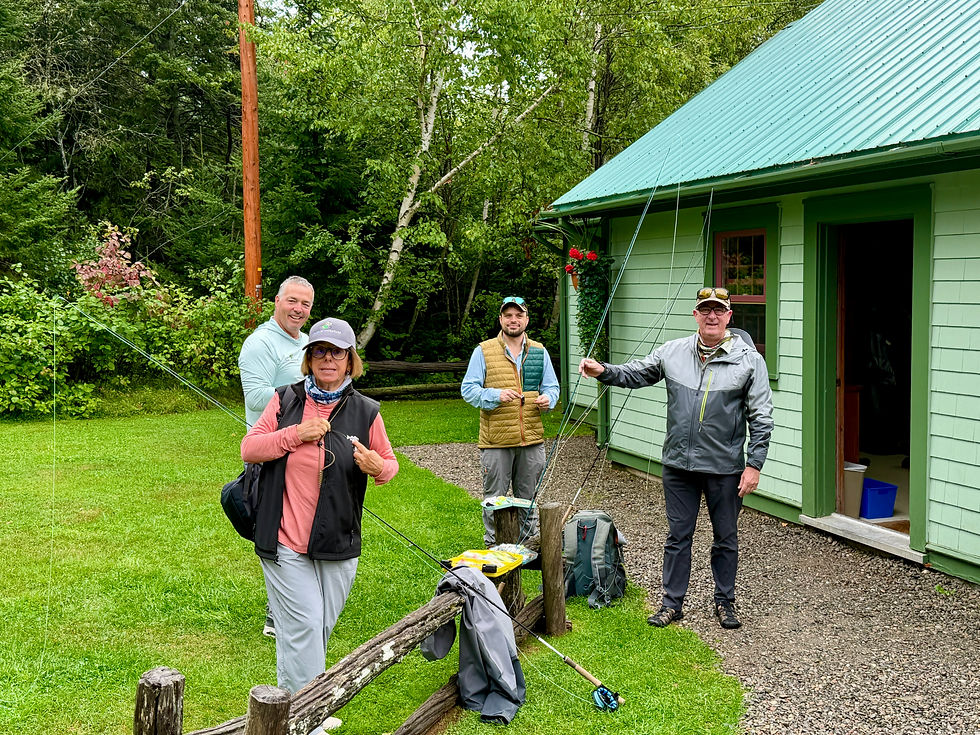
Each morning after breakfast we met our guides in the rod room adjacent to the camp’s administration building. There we learned of our destination and assigned guides for the day. For each day there was always one group directed to a fishing beat along the Bonaventure River to fish for salmon, while the other two groups would take to the flats for stripers. On the day I was selected to target Atlantic salmon, I was nervous and full of hope but kept expectations low.
Fishing access to the Bonaventure River is managed by the zone d'exploitation contrôlée, or ZEC, which is a non-profit organization that manages wildlife resources throughout the Province of Quebec. You must register in advance with the ZEC and submit to a lottery for assigned beats on each day, which the staff at Camp Bonaventure undertook on our behalf as well as securing fishing licenses for each of us. The managed section of the Bonaventure River comprises 90 salmon pools on 65 kilometers of river, approximately half of which is open access (without reservation) and the other half limited access (with reservation). The latter has a designated number of rod licenses available per day, ranging from 4 to 10 rods per beat.
There is no prescribed gear set up, per se. There will potentially be big fish, which would imply using a stronger rod. I fished a 9 foot, 8-weight Helios 2 rod and a Mirage reel outfitted with a saltwater floating line and a longer leader (12 – 15 feet) of a larger diameter (2 – 3x). After a while, and without any action, we moved to smaller diameter leaders (4 – 5x) thinking that the fish may be spooked by the stouter leader. Most flies were classic wet flies with feathered patterns and a single hook. We generally cast directly across or slightly upstream, letting the current sweep the fly for 10 – 15 feet. We then lifted, retrieved and took a few steps downstream to start over again.

All the while our guide was scoping out the downstream lies to identify fish. If the water was too deep or discolored to spot fish, the guide would use an inverted periscope to search the water for salmon. These devices are long, rectangular boxes, representing an optical device fitted with internal mirrors. Locally they are apparently nicknamed “look-a-dos” or “la boite” (the box in French). Until this trip to Bonaventure, I have never seen anything like it.
My day on the Bonaventure River turned out to be, as Lefty Kreh described, a lot of work for little reward. But I was never deterred and remained hopeful throughout the day – encouraged by my guide who reminded me that “there is still time”. In the end, I ran out of time, but other members of my group were fortunate to add an Atlantic salmon to their accomplishments.

Note: I am not being compensated for my mention of Orvis or Camp Bonaventure. I am simply a happy client.


Comments