
Fly fishing the Alentejo region of Portugal


I have been fly-fishing in several countries on the continent of Europe, including Spain, France and Italy. Despite having lived in Portugal in the 1990s and visiting repeatedly since then, I have never been on a fly-fishing excursion there - although it has not been for lack of trying! The trout fishing in the north of Portugal is reported to be quite good, but the two fishing guides I have reached out to there have been unresponsive, despite sending emails in both English and Portuguese.
So, when my wife identified an expatriate who promoted guided fishing in the Alentejo region, I was skeptical. Not just because of my unsuccessful attempts to arrange fly fishing excursions in the north, but also because I associate the Alentejo with pastimes other than fishing, such as touring ancient villages and enjoying excellent food and wine. I will get to the unexpectedly good fishing after an introduction to Portugal and the Alentejo region.

Portugal still harbors strong accents of Old-World Europe, and this is particularly true of the Alentejo region, an area which borders Spain. I have been traveling to this country regularly for over 30 years and continue to be impressed with how Portugal honors its past in a graceful and unassuming way.
The Alentejo is located between Lisbon and the Algarve, and stretches from the Atlantic ocean to the Spanish regions of western Extremadura and Andalucia. The name translates from Portuguese as ‘beyond the Tagus River’ and it is largely a domain of vast estates comprising olive trees and cork oak, for which the Alentejo has traditionally been known. But the region also has become an important tourism destination with an emerging reputation for great food and wine.

My journey to the Alentejo would begin along the Lisbon coast and traverse the picturesque 25 of April Bridge across the Tagus River (Rio Tejo). This suspension bridge links Lisbon to the Setúbal Peninsula to the south and looks like San Francisco’s Golden Gate bridge. The views from the bridge are spectacular with the Christ the King monument (Cristo Rei) serving as a beacon for traffic heading south.
The industrial zones along the highway into the Setúbal Peninsula quickly give way to the soothing landscape of cork and olive groves so emblematic of the arid Alentejo. Portugal is a prolific producer of cork with approximately two-thirds of total cork exports globally. And while its olive oil production is dwarfed by that of Spain, Italy or Greece, I prefer the rich pungent flavors of Portuguese olive oil to its more widely known competitors.

My host was Russell Hoad of Wild Fishing Portugal, an expatriate from the UK who has relocated to a tiny hamlet in the Alentejo to begin a new life guiding anglers and birding enthusiasts. I arranged to stay in Mértola and fish with him over two days on man-made waters situated near Amêndoeira do Campo, equidistant between Beja to the north and Mértola to the south. A feature of this area is the Guadiana Valley Natural Park which comprises prime hunting grounds and is one of the reasons Mértola considers itself the hunting capital of Portugal.
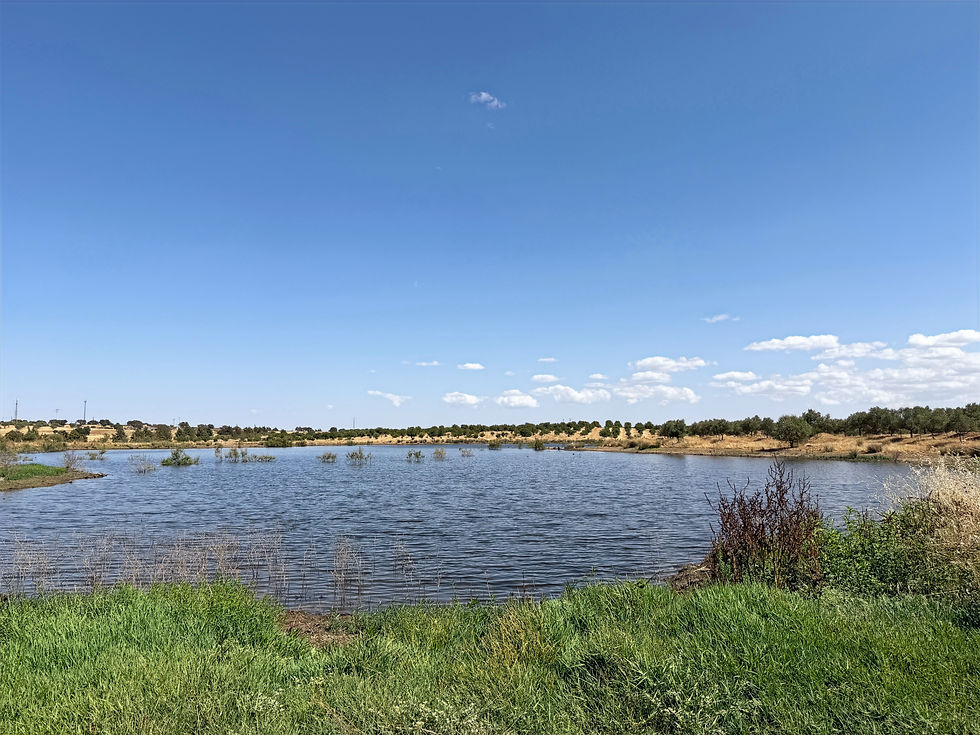
Most inland bodies of water (lakes and large reservoirs) in the Alentejo region are artificial (albufeiras), created through extensive dam and irrigation projects designed to combat the region's historically dry, drought-prone climate. These man-made water features comprise simple watering holes (pegões), ravines (ribeiras) and reservoirs (barragem). Many of these are teeming with freshwater fish and attract dozens of resident and migratory birds, including kingfishers, storks, herons, bee-eaters and hoopoes. Over two days of fishing, I would learn that my guide, Russell, is an authority on both, as well as an amiable companion on the water.
We targeted largemouth bass, carp and barbel on a variety of waters, but each of the two days began on a small watering hole, to which my guide has private access. There we spent the morning hooking up on fish after fish, all largemouth bass, using surface poppers, grasshopper patterns and a variety of streamers resembling crayfish – all of which were very effective and tied on a 3x diameter leader. Russell also provided the fly-fishing gear that comprised a 9-foot, 6 weight Orvis Clearwater rod and Battenkill reel. We fished comfortably from the banks, only wading in to retrieve a fly lodged on structure.

In the afternoons, we moved to the reservoirs in search of carp and barbel. These excursions were much more challenging as we stealthily roamed the banks to spot tailing fish or disturbances created by their foraging. At times we covered kilometers of shoreline without spotting a fish, made more arduous by the bright sun and steamy temperatures, but we persevered until a pod of fish were located. As difficult as it was to find the fish, this proved easier than getting the fish to eat. I am sure we experimented with at least a dozen different fly patterns, with only a handful of hookups to show for our efforts.
To be fair, Russell had warned me that the carp and barbel fishing during this time of year could be hit or miss. So, in the end, it was only the bass that found their way into the net. But I found a new appreciation for fly-fishing for warm water species, while surrounded by some spectacular scenery and exotic bird species. I look forward to returning with the hopes of landing my first barbel.
Tight lines!


Comments