
Trout fishing in Connecticut


Fly fishing for trout on the Salmon River
When I have home-alone status, I usually embark on a fly fishing adventure or two. On a recent opportunity, I was invited by a contributor to the Trout Bandit Blog, Carl Ochnio, to accompany him fishing in his home waters near Colchester, Connecticut. It is not a state where I have caught fish before, so I happily accepted and drove from North Virginia for a couple of days of trout fishing in eastern Connecticut.
Avid anglers of blue-ribbon waters may be questioning why I did not target more high profile trout water in Connecticut, such as the Farmington or Housatonic rivers (both are included in Trout Unlimited’s Guide to America’s 100 Best Trout Streams. This is a fair question for which I have a good answer. To begin with, I was being hosted by an angler with local knowledge of the Salmon River, which still ranks among the better trout streams in Connecticut. But also, I would be better located to drop in on some very good trout water in Western Rhode Island, another state where I have not caught fish before!

The town of Colchester is located in southeastern Connecticut and is described on the official city website as blending “small town charm with natural beauty”. I have no objection to this characterization as I found it to be genuinely bucolic, and the presence of the Comstock Covered Bridge within the Salmon River State Forest highlighted the merging of charm and nature attributed to the town.

My host’s home water happens to be the Salmon River, which is formed by the confluence of the Jeremy and Blackledge Rivers. We would target these as well as a tributary, the Dickinson Creek. All are very fishable waters and easily accessible. It is also possible to put several species of trout in the net – rainbow, brown, brook and tiger among them.
My host, Carl, has been fishing these waters for the better part of 60 years, and he demonstrated his intimate understanding of the river during our two days on the water. We began at the public parking area along the Salmon River just downstream of the covered bridge and made our way to various points further downstream. Carl has a label for each of his ‘honey holes’, which I have promised not to reveal, and we meticulously fished each of these along a stretch of water of approximately 2 miles in each direction down and back.
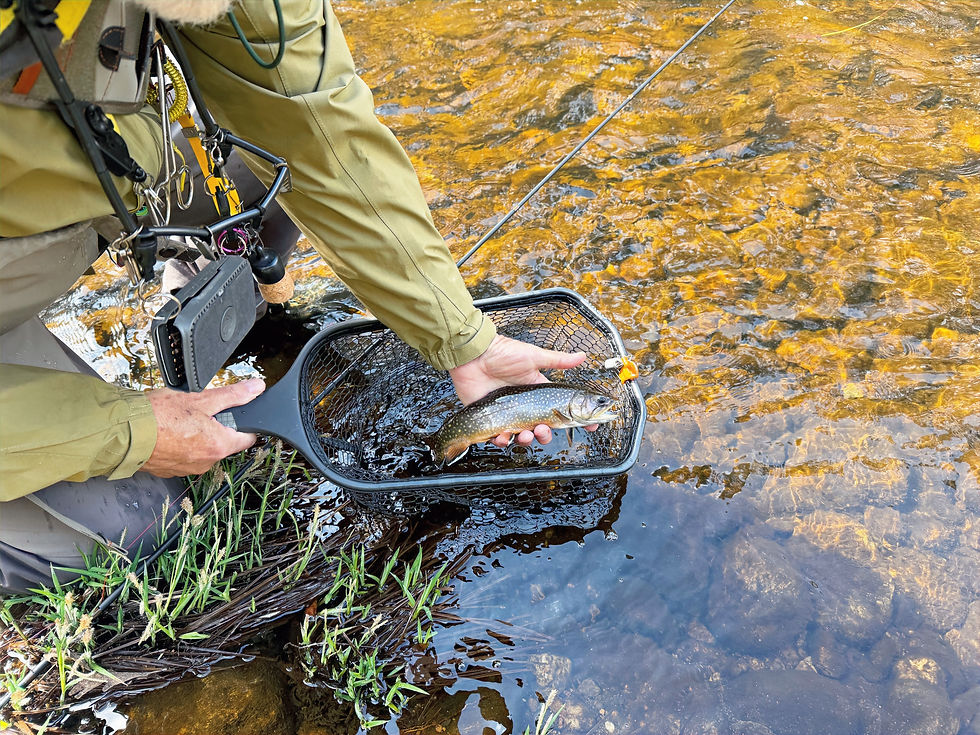
On this day, as he generally does during March and April, Carl travels light in terms of fly selection – he almost exclusively sticks to a tandem of a bead head Sexy Walt’s Worm trailing a stonefly nymph pattern (both of various sizes), and occasionally dips into a box containing soft hackles. He fishes the tandem of flies in a contact nymphing approach that is very effective - using a sighting leader. I fished the same tandem under a handmade Dorsey indicator made of wool. Carl’s tight line nymphing approach, along with his years of institutional knowledge, relegated me to 'grasshopper’ status on the tutelage scale, which I didn’t mind because I was enjoying this water immensely. I was also hooking up on plenty of trout and putting a good number of those fish in the net.
The following day, Carl introduced me to other waters in the Salmon River State Forest that may not be as well known. We began our second morning on the Dickinson Creek in the northern part of the state forest via an easy out and back hike of approximately 1.5 miles. It is the epitome of small stream trout fishing and underscores Joe Brooks advice that, while three casts are okay, two are better and one is perfect. It also reminded me of my experiences on waters of the Shenandoah - once you hook a fish in a particular pool, you then move on to the next one - and, of course, if your three casts have produced nothing, take that as your cue to likewise move on!

We then proceeded to the confluence of the Blackledge and the Jeremy rivers that feed the headwaters of the Salmon River. I should note that the latter also goes by Jeremy’s river and was featured in a 1974 Fly Fisherman article authored by the legendary Gary LaFontaine. In the article he demonstrated how technical that water can be and his results were better than ours.

So, with nothing to show for our efforts on the waters leading to the Salmon, we returned to the main event to fish the section for which this water is known – the mile-long fly fishing only section (FFO) within the Trout Management Area (TMA). This section upstream of the Comstock Covered Bridge is probably what the Salmon River is most known for, and certainly attracts the most attention from anglers, especially after stocking reports are released.
I wish I had trout water of this quality within a stone’s throw of my home.
Tight Lines!


Comments