
Trout fishing in Japan


Fly fishing for trout in Nagano
My initial thought was not to post a blog about my fly fishing excursion for trout in Nagano: primarily because the guiding experience was so disappointing, but also because there was virtually no catching over two days. However, fishing is not always about catching. And as my readers know well, I am always up for an adventure. On that basis it would be unfair to ignore that my fly-fishing in Nagano was interesting. So, I have decided to share the event with my readers.
The suggestion to fly fish in Nagano came from the TU Community Forum. I requested suggestions for fly fishing in Hokkaido, and a post from a member offered Nagano as a secondary option. A search on the web produced a guiding option in the Nagano area, which is easily reachable by high-speed train from Tokyo.
My guide agreed to collect me in Saku (on the high speed line from Tokyo) and drive us to Ueno village, about an hour away. He also arranged all the tackle and equipment – I only needed to bring wading pants and boots. Because we fished two consecutive days, he also arranged local accommodation, which was at a charming, family-operated inn. The accommodation was simple and typically Japanese, and the dinner was extraordinary.

The guide arranged for us to fish a portion of the Kanna River (Kannagawa) that had controlled access to seven different beats. The license for access cost 4,000 Yen (about $27 USD) and assigned a single angler to a beat for a six-hour day, from 9am to noon, and 1 pm to 4pm. At the completion of the day, we reported back to the beat administration building, which was part of a broader tourist rest stop area. This would be complicated for a Westerner to undertake without the assistance of a local guide because the process is in Japanese, including the reservation, license application and beat map.

Despite temperatures in the 80s, the conditions seemed promising. The Kanna River is a tailwater and the flow is controlled from the dam. The water temperature was also quite cool (in the mid- to high-50s). Although skies were partly cloudy to sunny, there was plenty of dense canopy sheltering the stream. The water was not unlike some of the mountain streams I have fished in Shenandoah National Park, but without the steep elevation change.

I was using a bamboo rod custom designed and handmade by my guide. It was a 7ft, 9” 0-weight, hollow and splice joint rod, which means it has no ferrule (so is coupled together with transparent electrical tape) and, thus, is considerably lighter than a conventional rod with nickel-silver ferrules. The rod was paired with a vintage reel from Carter & Sons of London, which, at 3 ½ inches, was also lightweight.
I had never fished a rod and reel set up this lightweight, so it took me most of the first morning to get a feel for how the line loaded on the backcast. On top of that, we were fishing single nymphs of size 16 and 18 under a wool indicator (tandem nymph rigs are not allowed), with a 7x diameter leader, which made it even harder to feel the line straightening out behind me. Compared to my 6 ½ ft, 3 weight rod with mountain stream leader, casting this outfit felt like I was whipping a thin reed above my head.

We accessed the beats via a paved road and then followed marked trails down to the water into a ravine characterized by uneven topography on the banks and slick rocks on the riverbed. I had felt-soled shoes, but could have used a wading staff for balance. I fished methodically and nymphs were changed often due to the lack of production.
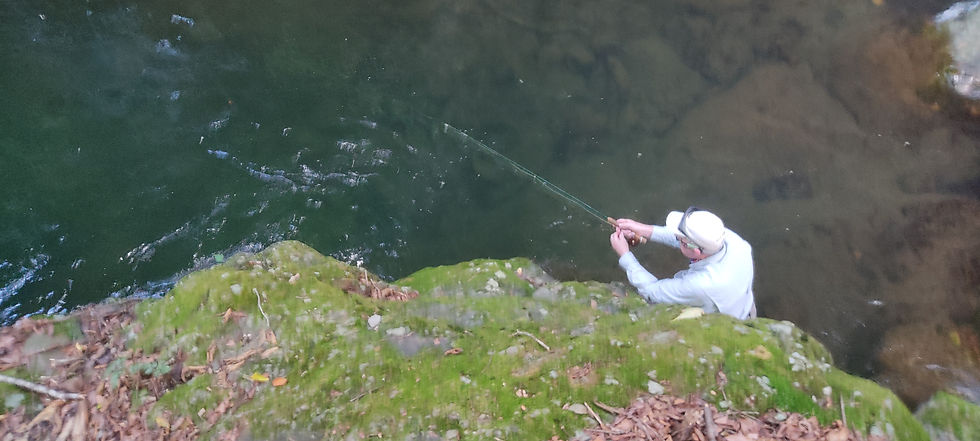
We mostly nymphed along seams of runs and deep channels or holes and saw plenty of the species that we were targeting - yamame, iwana and holdover hako steelhead. We also saw stocking trucks on both days dumping fish into some of the larger holes. We had follows, but few takes, most of which were very subtle. In fact, over two days of fishing I recall only one viable opportunity for a hook up. I could tell my guide was increasingly concerned as the first day produced nothing and the second day evolved into a repeat.
I can only ponder the reasons for lack of activity. It was easy to identify the stocked fish introduced into the stream that day – they were large and exhibited erratic behavior. Did that affect the resident fish? The temperatures were in the 80s. Did that sink the fish and were the flies drifting too shallow? It was a full moon that weekend. Did that affect the bite? Two days of fairly focused fly fishing produced very little action, which suggests that something was not right.
Conditions aside, I was disappointed that my guide did not take the initiative to do more than just change out the flies. Worse, he seemed sullen from start to finish and did not respond to my efforts to lift the mood with lighthearted banter, nor did he offer advice or change tactics when I suggested that input was needed. To say he was eccentric would be generous; he seemed ill-mannered, anti-social and entirely unsuited to guiding. The lack of desire on his part to develop any camaraderie wore heavily on me over the course of the two days.
As readers of my blog know, I enjoy employing guiding services on new and unfamiliar water as it both enhances the experience for me and fast-tracks my knowledge base of the area. In 30 years of fly-fishing, I have been a regular guiding client and have been fortunate that the majority of these services have been of great value. In fact, in more than 100 posts on the Trout Bandit blog, I do not think there has been one account of an underwhelming guiding experience. That speaks volumes about this particular guide service, which will remain unnamed.
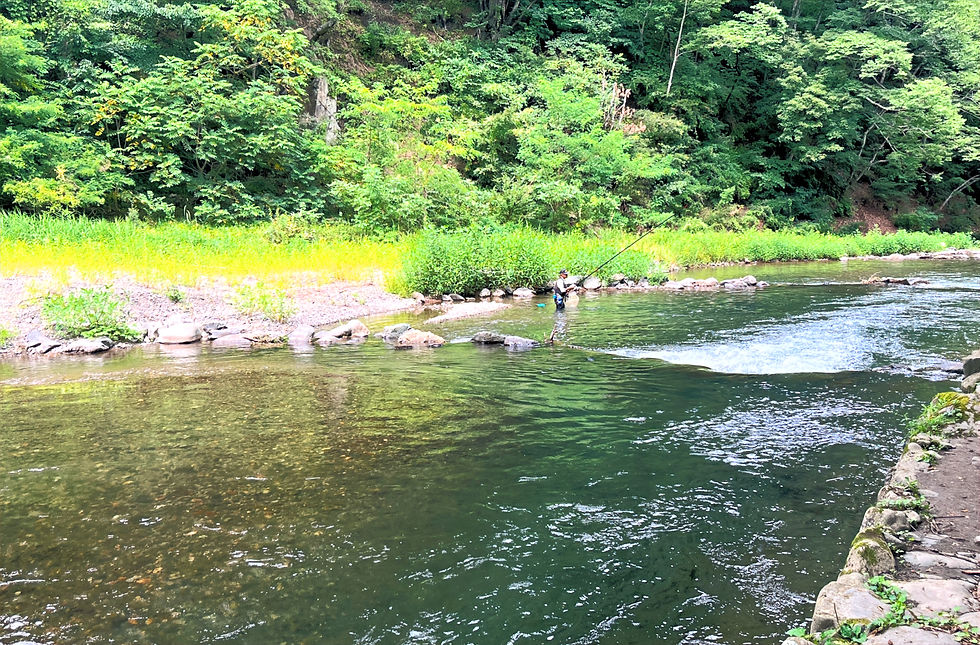
I do not regret choosing to travel to Nagano for fishing. For me it is all about the adventure and there was plenty of that to be had. To begin with, I witnessed an angling culture that I had not yet seen in Asia – fishing for Haya (a species of chub) is a local sport. These anglers are as serious about their sport as our American bass anglers are – complete with colorful kit and expensive gear. One angler speaking to my guide admitted he paid $4,000 USD for his 15-foot carbon fiber rod.
I also had another welcoming dose of Japanese hospitality (with the exception of my guide), which has made me an enduring fan of the country and the culture!


Comments